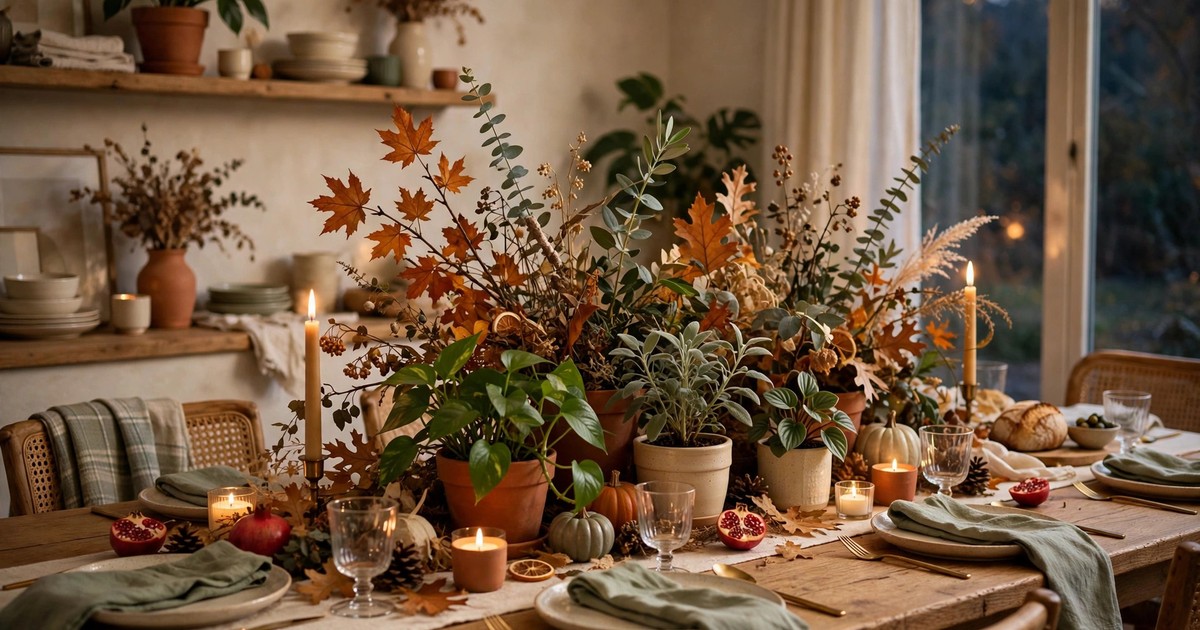
Thanksgiving tables are made for abundance, but florist centrepieces are priced for it too — a single professional arrangement can cost $75 or more, and it dies in a week. Here's the better plan: build your centrepiece from houseplants you already own and branches you forage for free. The result looks lush, expensive, and editorial, costs almost nothing, and every plant goes back to its pot when the guests leave.
This is a genuinely renter-friendly project: no drilling, no staining the table, no permanent anything. Give yourself about an hour, ideally the morning of or the day before Thanksgiving, and follow these six steps.
Step 1: Shop your own plant collection first

Before you buy a single stem, walk around your flat with a tray and gather candidates. What works best for a centrepiece: compact, architectural plants that look good from every angle — small snake plants, pothos in nursery pots, a trailing philodendron, succulents, or a little fern. Aim for five to seven plants in mixed heights.
Leave the fussy divas where they are. Anything that wilts dramatically within hours (looking at you, calathea) stays on the shelf. You're borrowing these plants for one evening, not stress-testing them. Water them normally the day before so they're perky, and keep each one in its own pot — you'll never disturb the roots, which means zero plant casualties.
Step 2: Forage branches, pods, and grasses for free

This is where the magic — and the savings — happen. Fall branches with turning leaves, dried seed pods, ornamental grasses, and bare twiggy branches are the backbone of an expensive-looking arrangement, and they're free. Good sources: your own garden or balcony pots, parks (take fallen branches from the ground, not living trees), and roadside verges.
Stick to the rules: never cut living branches in public parks, never take from anyone's garden, and avoid anything with berries unless you can identify them — some are toxic to pets. Bring secateurs and a tote bag. You'll want 8–12 stems of varying lengths, plus a handful of smaller filler bits like dried grasses or interesting seed pods. Shake off any insects outside before bringing them in.
Step 3: Choose a low, neutral vessel you already own
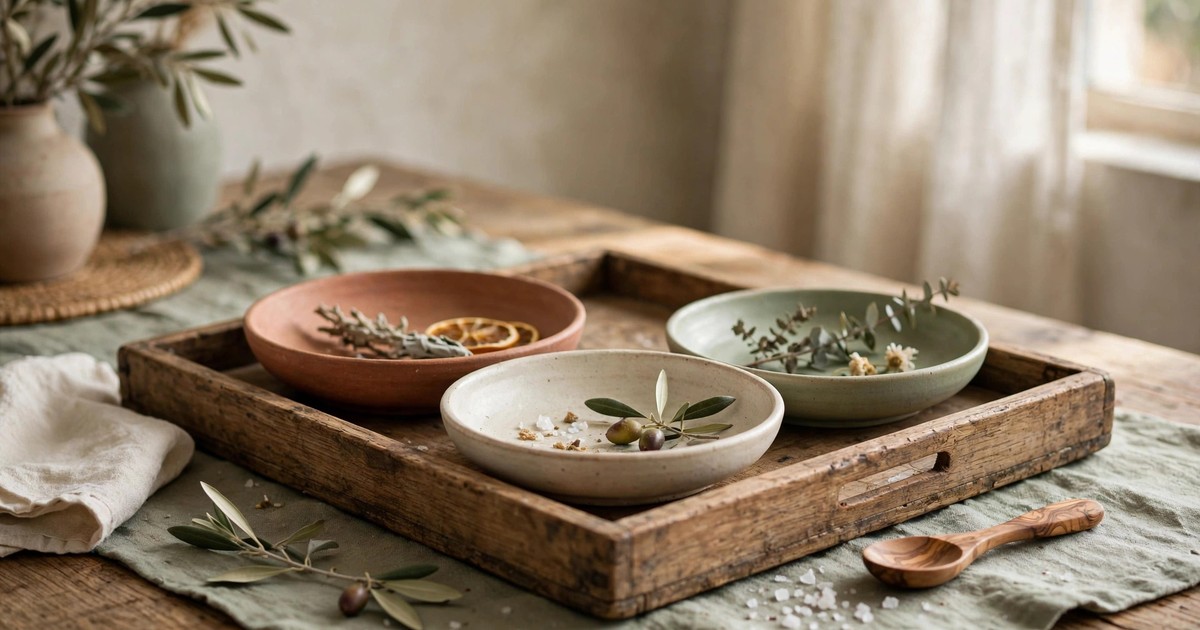
A Thanksgiving centrepiece has one non-negotiable job: stay low enough that guests can see each other across the table. Skip tall vases. What you want is a long, low tray, a shallow wooden bowl, a baking sheet lined with a tea towel in a pinch — anything that keeps the whole arrangement under about 30 cm tall.
Neutral materials work hardest here: wood, stoneware, linen, or matte ceramic in cream, terracotta, or sage. They let the plants and branches be the stars. If your tray is dark wood, lay a strip of cream or oatmeal linen down the centre first — it brightens everything and protects the table underneath (your landlord thanks you). One long vessel reads more elegant than five scattered small pots, so corral everything into a single container if you can.
Step 4: Anchor the arrangement with tall branches
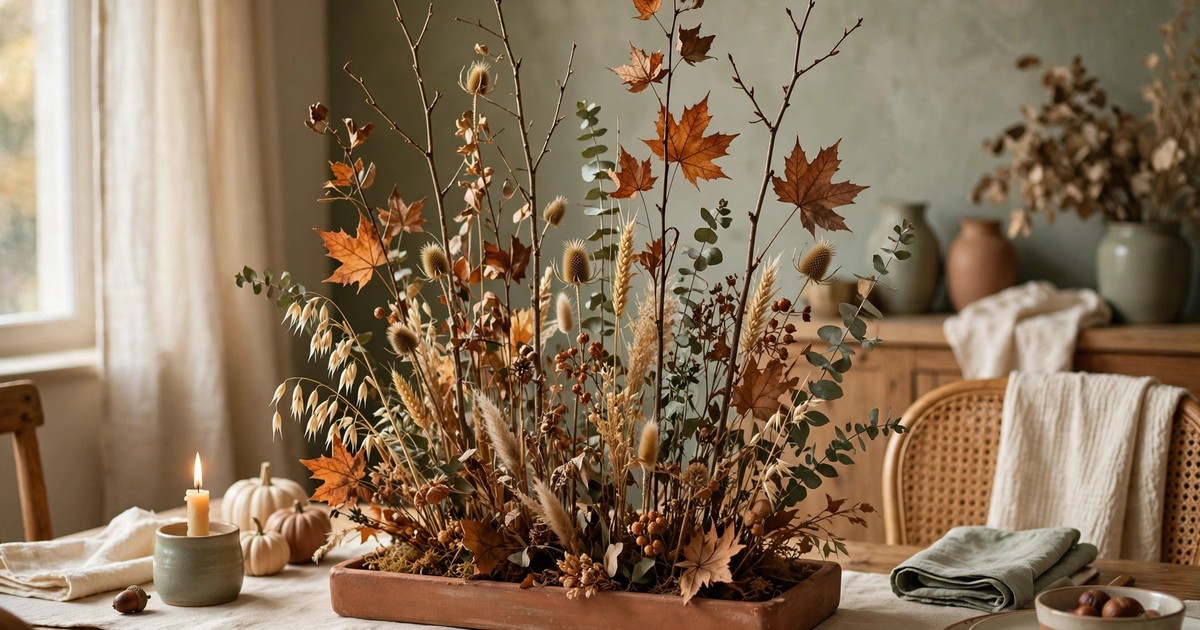
Start with the foraged branches, because they give you the skeleton. Trim stems to graduated heights — the tallest at the centre-back, shorter toward the ends — and wedge them firmly into the tray. If they wobble, ball up some chicken wire or crumpled newspaper inside the vessel and push the stems through it. Florist foam works too, but the wire-and-paper method is free and reusable.
Step back and look at the silhouette from the doorway. You want an airy, asymmetric shape — not a symmetrical blob. Odd numbers of tall stems (three or five) always look more natural than even ones. The branches should read as elegant line and movement, framing the space above the table without blocking anyone's view.
Step 5: Tuck houseplants in at three heights
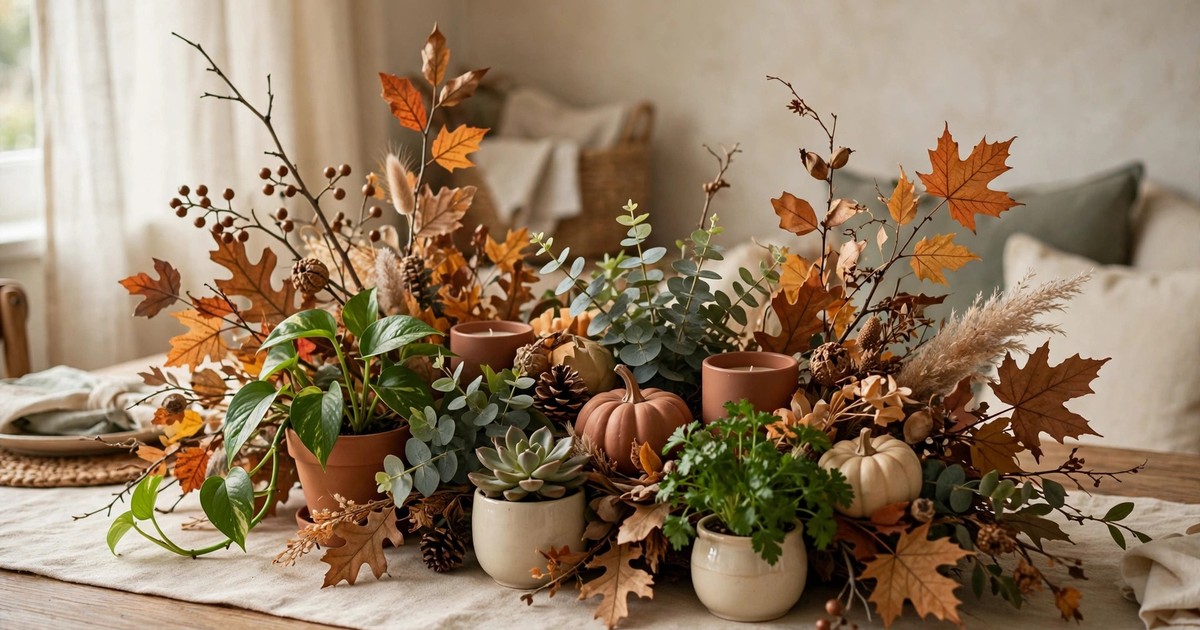
Now nestle your potted plants among the branches, still in their pots, hidden by foliage. Work in three layers: a tall upright plant (snake plant, small bird of paradise) near the centre, medium plants (pothos, fern) filling the middle, and one trailing plant (trailing pothos or philodendron) spilling over the front edge of the tray for that abundant, overflowing look.
Turn each pot so its best side faces out, and push moss, dried leaves, or even crumpled kraft paper around the pot rims to hide the plastic. This is the florist's oldest trick — the "mechanics" should be invisible. Stand back again: if you can see a nursery pot from any seat at the table, tuck more filler around it. From the guests' side, it should look like one continuous garden.
Step 6: Add candlelight and a simple runner to finish
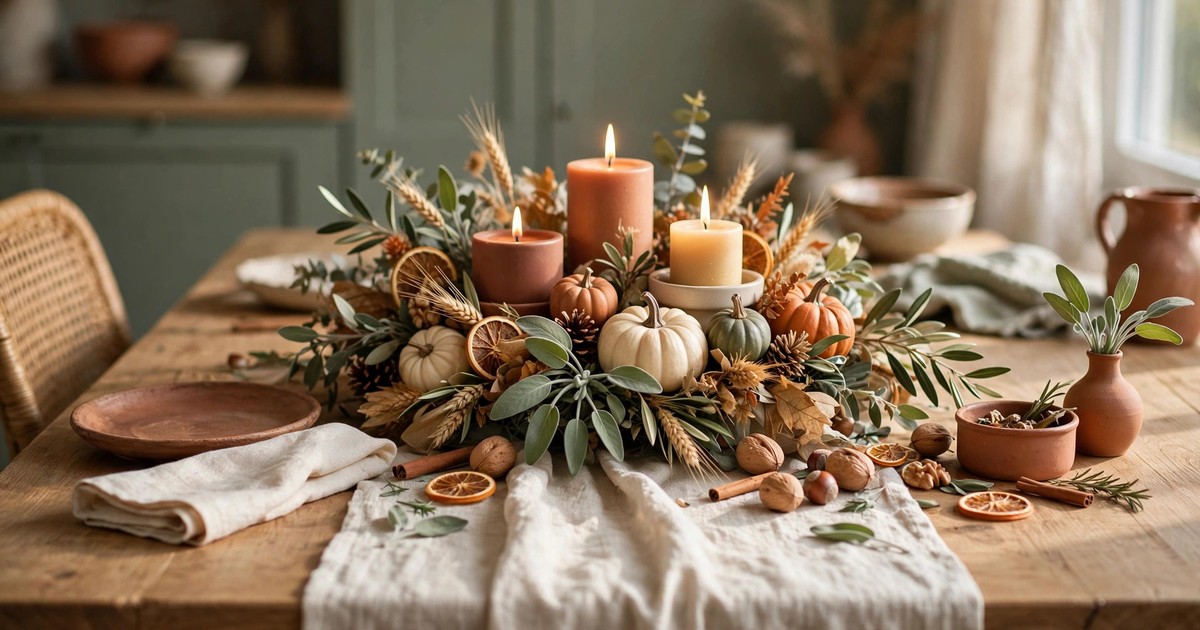
The final layer is light. Tuck three to five candles of varying heights into the arrangement — but keep every flame at least 15 cm from any leaf or dried grass, because dried botanicals are flammable. Battery-operated pillar candles are the stress-free renter choice: all the glow, zero fire risk, and you can reuse them at Christmas.
Underneath it all, a simple runner pulls the whole table together. A strip of linen, a length of kraft paper you can write guests' names on, or even a neutral throw folded lengthwise — anything long and low-contrast. Then stand back from the doorway one last time. If it looks abundant from there, it will photograph beautifully, which is half the point of Thanksgiving.
Frequently Asked Questions
Will my houseplants survive being in a centrepiece?
Yes — because you're not repotting or disturbing them. They sit in their own pots for a few hours in normal room conditions, then go back to their spots. The only risk is candle heat, so keep flames well away from leaves. Water them the day before, not the day of, so the pots aren't dripping on the table.
Where can I forage branches without breaking rules?
Take only fallen branches from public ground — parks, verges, your own street. Never cut living branches from public trees or gardens, and never take from private property. Late autumn is ideal because storms bring down plenty of interesting material. Shake everything outdoors to evict insects before bringing it inside.
How far ahead can I build the centrepiece?
Build the branch skeleton up to three days ahead — bare branches don't wilt. Add the houseplants the morning of Thanksgiving so they look their freshest, and place candles last. If you use any fresh-cut greenery mixed in, give the stems a fresh angled cut and stand them in small water tubes hidden among the pots.
I don't own enough plants. What are my options?
Borrow from a plant-loving friend (offer to return them with a slice of pie), or buy two or three small $5–8 plants from a supermarket — pothos and snake plants are cheap everywhere and you'll keep them for years. Faux plants also work mixed deep in the arrangement where nobody inspects closely; save the real ones for the front edge.
Is this safe with candles and dried branches?
Use battery-operated candles and it's completely safe. If you insist on real flames, keep every flame 15 cm from any dried material, never leave the table unattended, and skip the dried grasses closest to the candles. Honestly, the LED pillars have gotten so good that guests can't tell the difference in evening light.