Kwanzaa runs from 26 December to 1 January, and it is a beautiful week to celebrate in a small rented flat. The holiday, created in 1966, honours African heritage and community through seven principles — the Nguzo Saba — one for each day: unity (Umoja), self-determination (Kujichagulia), collective work and responsibility (Ujima), cooperative economics (Ujamaa), purpose (Nia), creativity (Kuumba) and faith (Imani). A Kwanzaa display is not about filling every surface; it is about gathering a few meaningful objects together — a kinara, a woven mat, a cup, some fruit and corn — and letting the colours red, black and green carry the celebration. That makes it one of the most renter-friendly holidays of all: the whole display fits on a sideboard, a shelf or a coffee table, and every single piece can be packed away in January without leaving a mark on the walls.
Everything in this list follows three rules. Nothing needs paint, drilling or nails. Nothing costs a fortune — most ideas come in under $25, and several cost nothing at all if you use things you already own. And everything works in a small space, because Kwanzaa decor was never meant to sprawl. A single well-styled surface, a few textiles in the right colours and some warm light are all it takes to make a studio or one-bedroom flat feel festive, welcoming and full of meaning. Budget around $70 to $90 for the whole look, or pick three or four favourites and have a complete, beautiful display for under $40.
These ten ideas are the ones that actually work in rented rooms. They are small, light and affordable, and they look far more considered than they cost once the candles are lit and the red, black and green come together. Work through them in order, or pick the ones that suit your space — either way, your deposit stays safe and your home feels ready for the week ahead.
1. Make the kinara the centrepiece
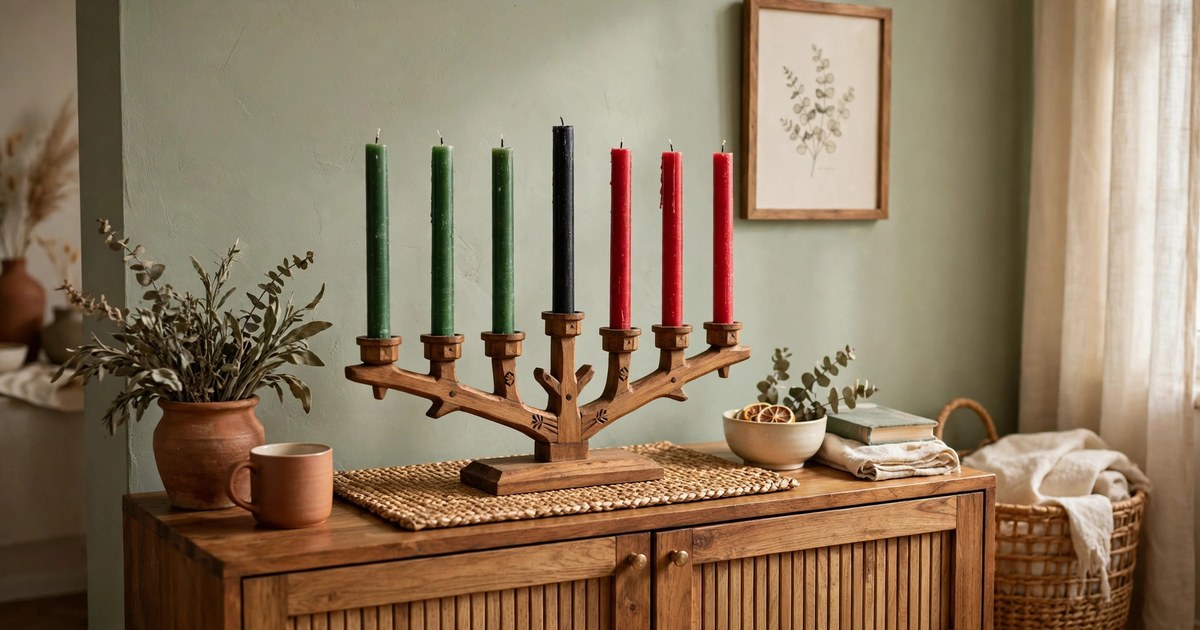
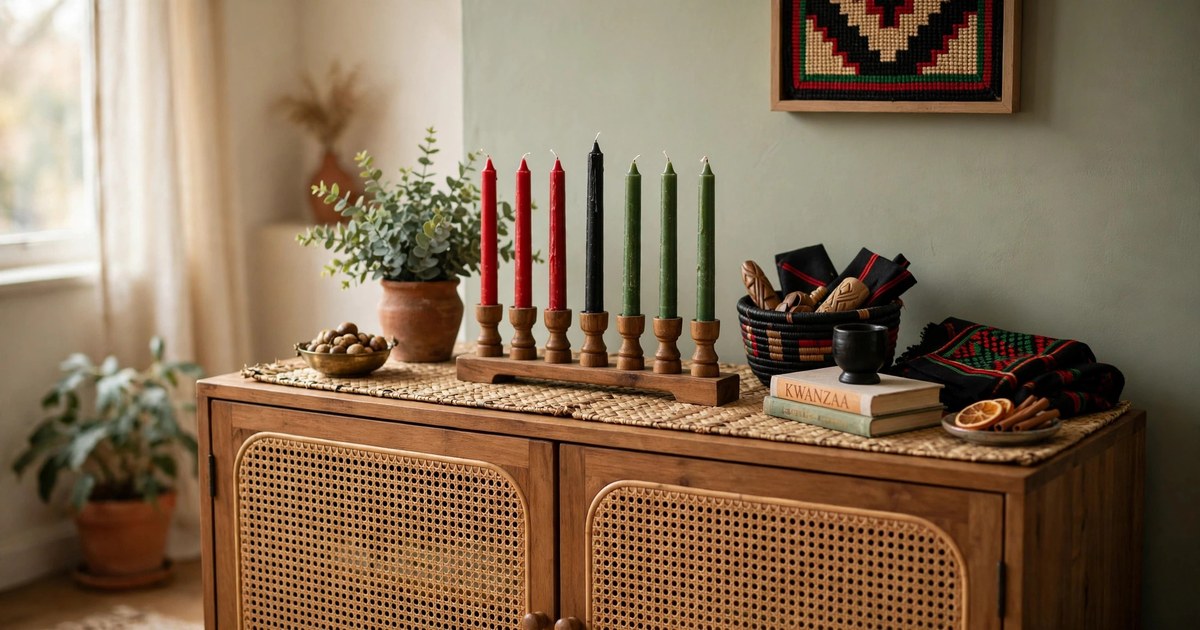
The kinara is the heart of every Kwanzaa display, and it deserves the best spot in the room. This seven-branched candle holder carries one black candle in the centre for unity, three red candles on the left and three green candles on the right, and a new candle is lit each evening of the week. In a small flat, the kinara does not need a mantelpiece or a grand dining table — a sideboard, a console table, a sturdy shelf or even the top of a bookcase works perfectly, as long as the surface is flat, stable and away from curtains, bedding and anything flammable. Give it breathing room: a clear patch of surface about the width of two dinner plates is enough, and it keeps the display feeling deliberate rather than crowded.
Choose a kinara that suits your space and your budget. A simple wooden kinara is the classic choice and usually costs between $15 and $25; painted or carved versions cost a little more but become keepsakes you bring out every year. If your tenancy agreement bans open flames — and many do — a kinara with battery-operated taper candles gives you the same nightly ritual with none of the worry, and flameless candles in red, black and green look genuinely warm once the room lights are low. Whichever you choose, keep a small tray or a heatproof mat underneath it. A woven placemat or a ceramic tile protects the furniture from wax drips and heat marks, which is exactly the sort of small precaution that keeps a deposit intact.
Style the kinara as a proper centrepiece rather than a lone object on an empty surface. Flank it with a small plant, a framed print or a stack of books, and let the candles be the tallest thing in the arrangement so the eye lands on them first. Light one candle each evening, talk through the principle of the day if you are celebrating with family or friends, and let the display grow brighter through the week. By the final evening, with all seven candles glowing, a small sideboard display feels as grand as any fireplace mantel.
2. A mkeka woven mat under the display
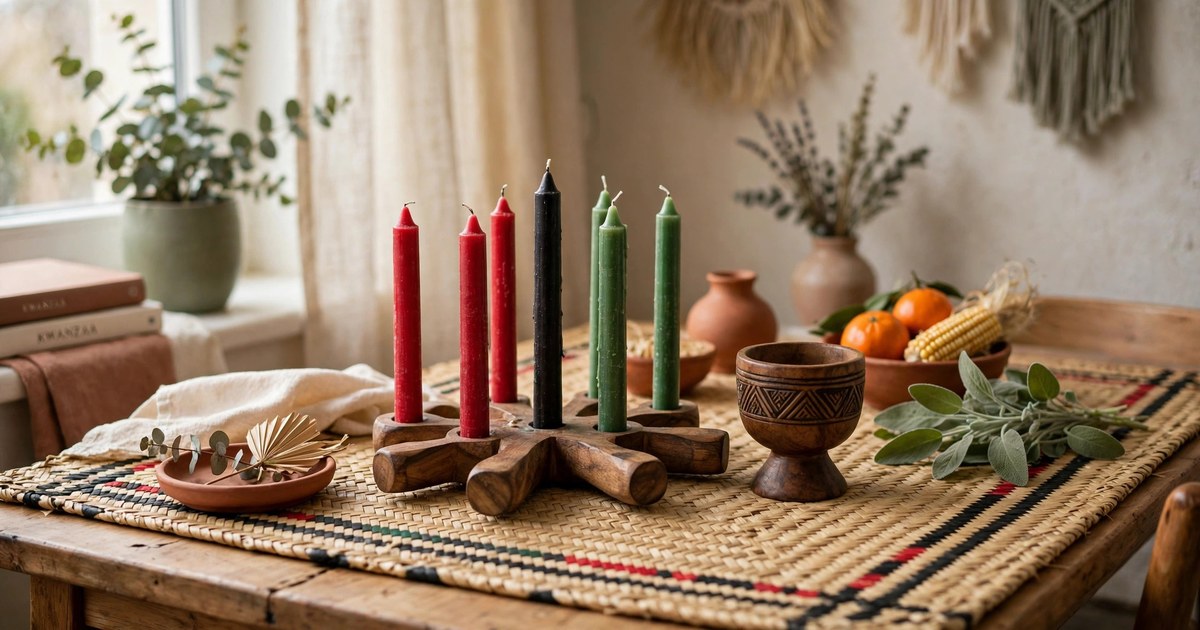
The mkeka is the woven straw mat that sits beneath the whole Kwanzaa display, and it is the single easiest way to make your arrangement look intentional. In tradition the mat symbolises the foundation on which everything else rests — history, culture and community — and in decorating terms it does exactly the same job: it gathers the kinara, the cup, the fruit and the corn into one neat, defined display instead of a scatter of objects across a tabletop. A straw or woven-grass mat in natural tones costs around $8 to $15, and it instantly makes even a borrowed sideboard look styled.
A mkeka is also wonderfully practical in a rental. It protects the surface underneath from wax, candle heat and the odd knock from a fruit basket, and when the week is over you simply roll it up and store it flat for next year. Choose a mat that is a little larger than your display — roughly 45 by 60 centimetres suits most sideboards — so there is a visible border of woven straw around the objects. If you cannot find a mat labelled as a mkeka, any woven straw, seagrass or jute placemat in a natural tone does the job beautifully, and a large woven table runner works just as well on a wider surface.
Layer the mat over a runner or a folded piece of kente-inspired fabric for extra colour. The straw tones sit beautifully against deep red, black and green, and the texture stops a display of smooth candle holders and glossy fruit from feeling flat. This is one of those small, cheap purchases that transforms the whole look: without the mat you have objects on a table, and with it you have a display. Keep the mat flat and dry in storage, and it will last for many Kwanzaas to come.
3. Kente-inspired cushion covers
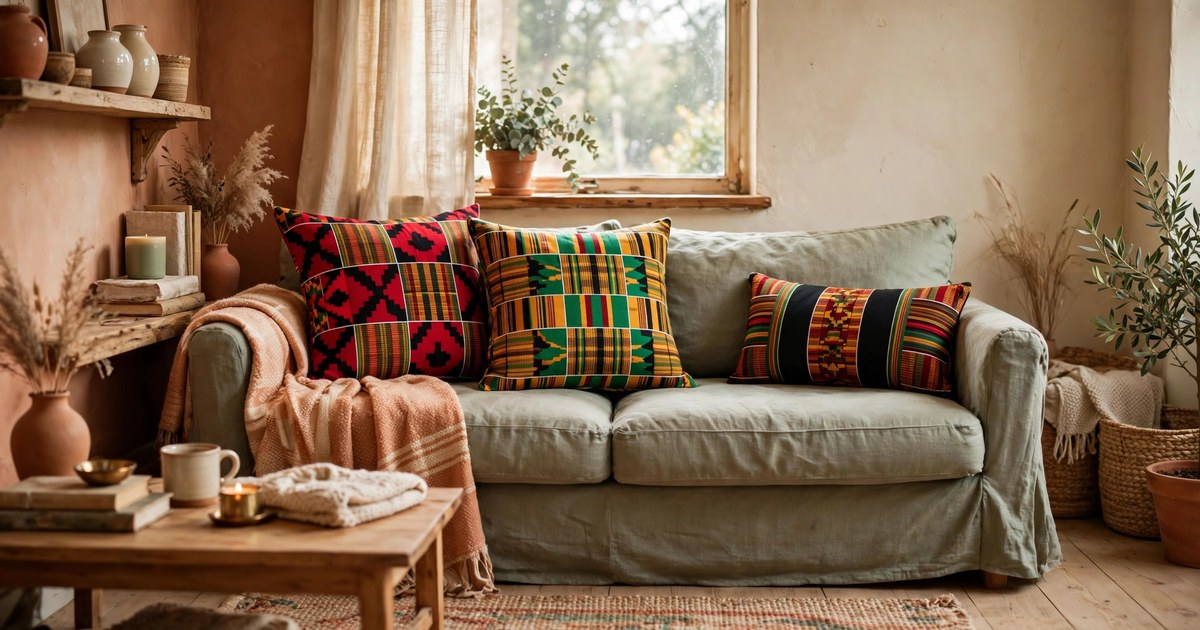
Kente cloth, with its bold woven stripes in red, gold, green and black, is one of the most recognisable textiles in African heritage, and a pair of kente-inspired cushion covers is the fastest way to bring Kwanzaa colours into a living room without touching a wall. Cushion covers are the renter's best friend at festival time: they slip over the cushions you already own, they cost around $10 to $18 for a pair, and they come off in January and go straight into a drawer until next year. No paint, no pins, no damage — just colour, pattern and warmth exactly where you sit.
Choose covers in a bold kente-style stripe or a geometric African print, and pair them with the cushions you already have rather than buying new inserts. Two patterned covers on a plain sofa are enough; add a third in a solid deep red or forest green if you want a richer look, and keep the rest of the sofa plain so the pattern has room to breathe. A standard 45-centimetre square fits most sofa cushions, and a zip closure makes swapping them a two-minute job. Look for covers in a cotton or linen-look fabric rather than shiny polyester — the matte texture reads as far more expensive and sits better with the warm, natural palette of the rest of your display.
The beauty of this idea is how far it reaches for so little money. The cushions are the first thing anyone sees when they walk into the room, so the whole flat reads as decorated even before they notice the kinara on the sideboard. When the week ends, swap the covers back and the room returns to normal in minutes. It is also a lovely way to involve children: let them choose which patterned cover goes where, and the sofa becomes part of the celebration rather than just furniture.
4. A red, black and green candle trio
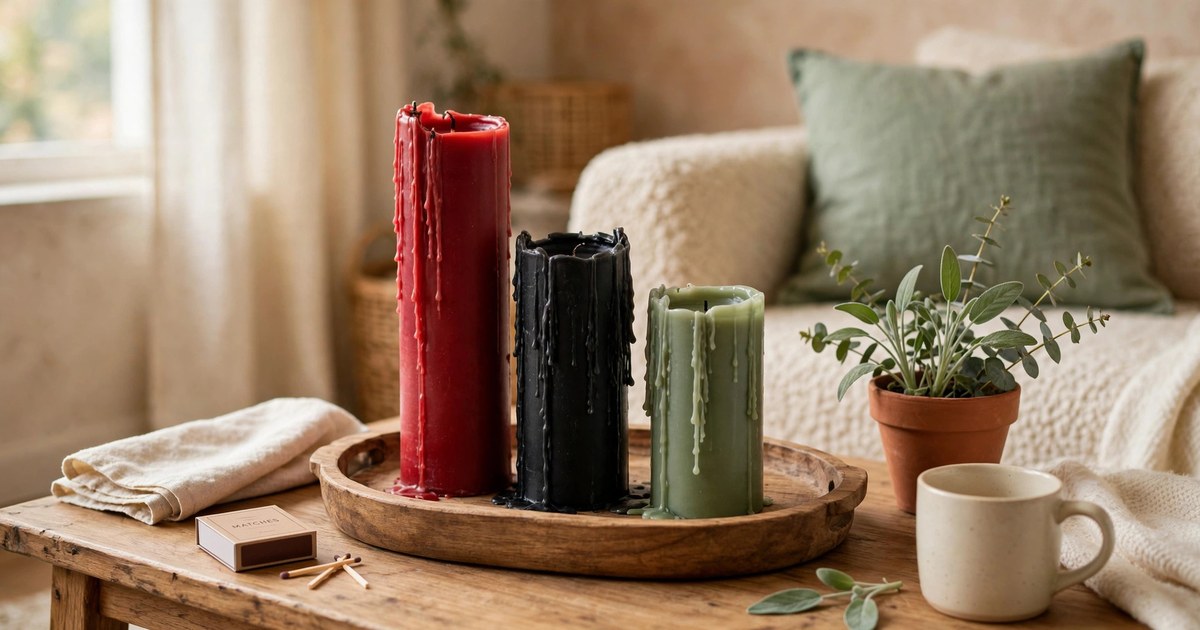
If the kinara is the centrepiece, a small trio of candles in red, black and green is the echo that carries the Kwanzaa palette through the rest of the room. Three pillar or taper candles in the three Kwanzaa colours, grouped on a coffee table, a windowsill or a bedside table, repeat the colours of the main display without repeating the display itself, and they cost very little — a set of three usually runs to $8 to $15. The key is grouping: three candles of different heights on a single tray or plate look deliberate and styled, while three candles scattered around a room just look like clutter.
Keep the grouping tight and low. A small wooden tray, a ceramic plate or a round woven coaster underneath the candles protects the surface and pulls the trio together visually. Vary the heights — a tall taper, a medium pillar and a short votive — so the arrangement has shape, and keep the colours in the same order as the kinara if you can: black in the middle, red on one side and green on the other. Battery-operated candles are the safest choice in a rental, especially on a windowsill near curtains or on a bedside table, and the flickering LED versions look convincingly warm once the main lights are dimmed.
This is also a lovely idea for rooms that cannot hold the main display. A candle trio on a bedroom dresser or in a hallway brings the celebration into the whole flat rather than leaving it in the living room, and because each trio is so small and cheap, you can afford two or three of them. Just remember the renter's golden rule with any real flame: never leave a lit candle unattended, keep it away from fabric and paper, and blow it out before you leave the room. Flameless candles remove the worry entirely, and they are the better choice if you have children or pets in the flat.
5. African print wall hangings on Command hooks
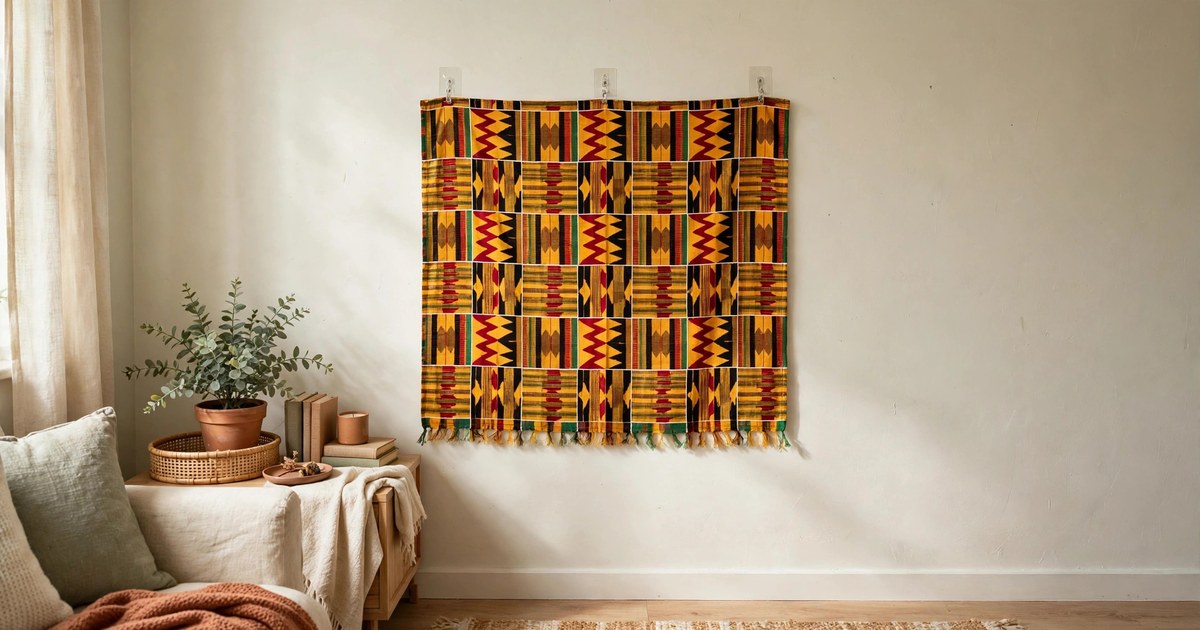
A wall hanging in a bold African print is the most dramatic single piece you can add to a Kwanzaa display, and removable adhesive hooks make it completely deposit-safe. A lightweight cotton tapestry or fabric panel in kente, mudcloth or Ankara-style print, hung on two or three Command-style hooks, turns a blank rental wall into a backdrop for the whole celebration — and when the week is over, the hooks peel away cleanly, leaving no holes, no marks and no awkward conversation with the landlord. A small wall hanging costs around $12 to $20, and the hooks cost a few pounds more.
Hang the fabric behind or beside the kinara display so the two work together: the print becomes the backdrop and the candles become the foreground. A piece about 75 by 100 centimetres suits the wall above a sideboard or a sofa; anything much larger can overwhelm a small room, and anything much smaller gets lost. Use the hook weight rating as your guide — a light cotton hanging needs only small hooks, but check the rating and use one more hook than you think you need, spaced evenly across the top edge so the fabric hangs straight. Clip-on curtain rings or small wooden dowels threaded through a top hem give a neater finish than pinning the fabric directly.
If a full tapestry feels like too much, a smaller fabric panel in a frame — or simply draped over a picture ledge — gives the same colour and pattern on a smaller scale. You can also hang a piece of kente-inspired fabric over the back of a chair or across a bookshelf for a softer, less formal effect. The point is the same either way: bold pattern, zero damage, and a wall that feels celebrated rather than empty. Store the fabric folded flat in a drawer and it will be ready to hang again next December.
6. A woven basket fruit display (mazao)
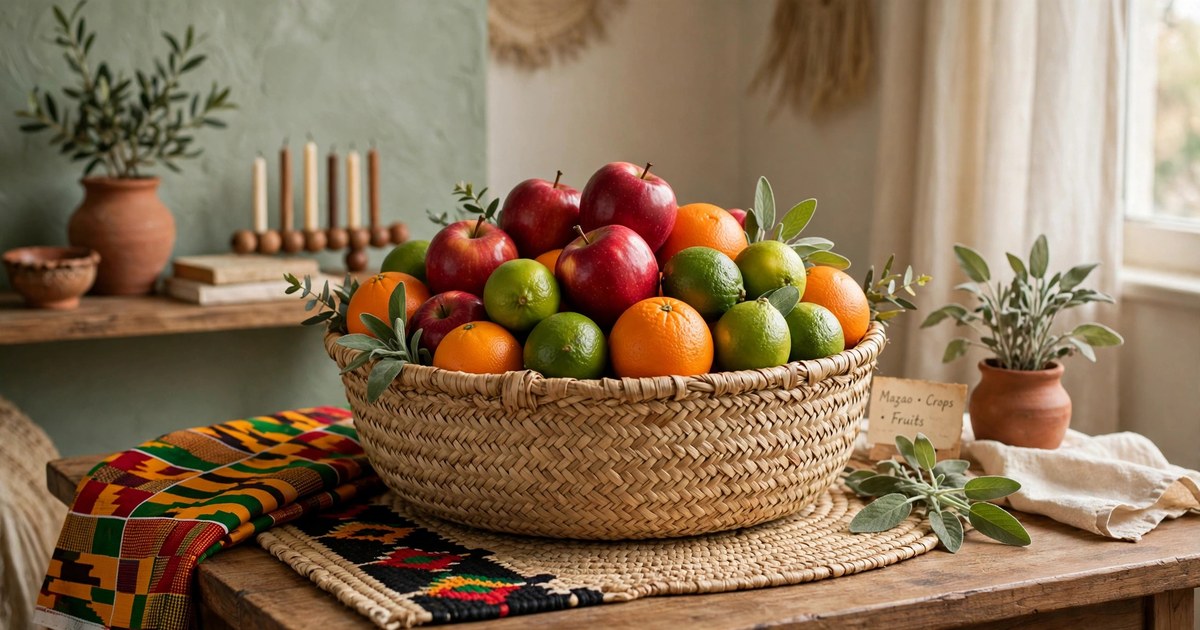
Mazao, the crops, are the fruit and vegetables placed on the Kwanzaa display to symbolise the harvest and the fruits of collective labour, and a woven basket of fruit is one of the loveliest — and cheapest — parts of the whole celebration. A shallow seagrass or wicker basket filled with oranges, apples, bananas and a few nuts costs little more than the fruit itself, and it adds colour, texture and a wonderful scent to the display. The basket usually costs $8 to $15, and the fruit is food you would buy anyway, so this is arguably the best-value idea on the list.
Choose fruit in Kwanzaa colours where you can: deep red apples, bright oranges, green limes and dark grapes make the basket look abundant and intentional rather than like a shopping bag tipped onto a table. Arrange the largest pieces at the bottom and the smallest on top, tuck a few sprigs of greenery or dried leaves between the fruit, and set the basket beside the kinara on the mkeka mat so it reads as part of the same display. A low, wide basket works better than a tall narrow one on a small surface, because it keeps the arrangement stable and leaves the kinara as the tallest object.
The practical bonus is that nothing is wasted. Eat the fruit through the week, top the basket up as it empties, and at the end of Kwanzaa the basket goes back into service as storage — for throws, magazines, yarn or the children's toys. That is the renter-friendly, budget-first spirit in a nutshell: buy something beautiful, use it for the celebration, then keep using it all year. A woven basket is never a single-use decoration, and that is exactly why it earns its place on the list.
7. Styling the unity cup (kikombe cha umoja)
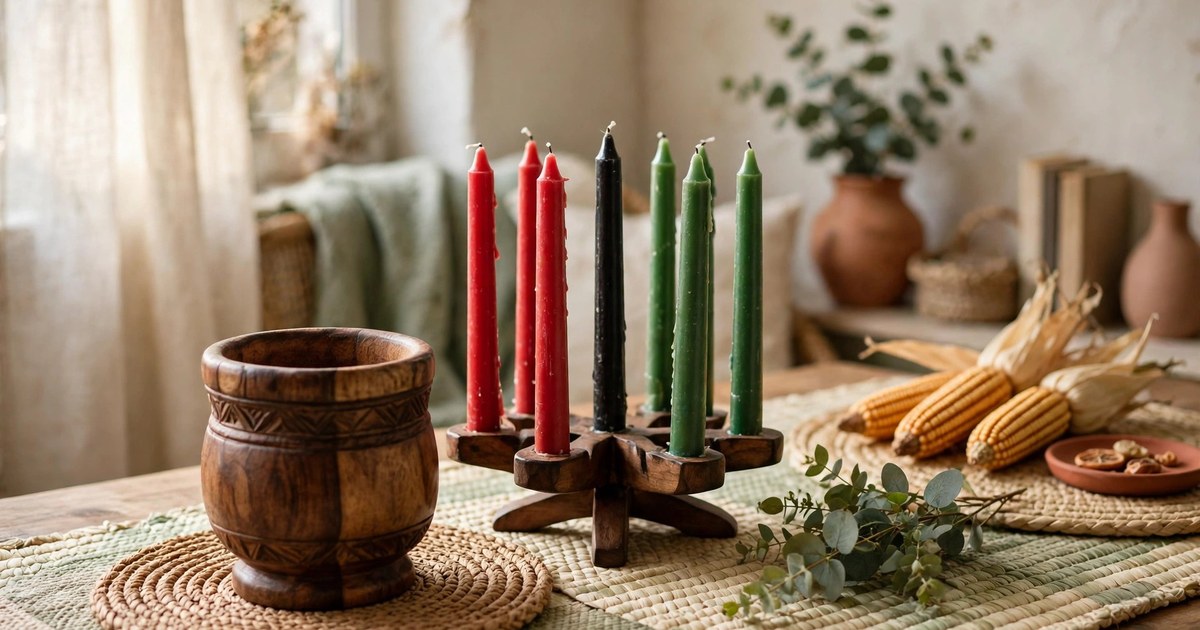
The kikombe cha umoja, the unity cup, is used in the Kwanzaa libation ceremony, when water or juice is poured in honour of ancestors and shared among those gathered. It is a small object with a large meaning, and styling it well is a quiet, thoughtful part of the display. Any beautiful cup, goblet or small vessel can serve as a unity cup — a wooden goblet, a ceramic cup or a brass tumbler all work — and a purpose-made one costs around $10 to $20 if you want something traditional. The cup sits on the mkeka mat beside the kinara, usually with a small plate or coaster underneath it.
Give the cup a little ceremony of its own in the styling. Place it on a small woven coaster or a folded piece of fabric, and set a sprig of greenery or a single flower beside it so it reads as a place of honour rather than an afterthought. If you are celebrating with family, the cup is passed or poured from during the libation, so keep it within easy reach of where people gather — the coffee table works beautifully for this — and use water or juice rather than anything that might stain the mat or the furniture if it spills. A coaster underneath is not optional here; it is the difference between a meaningful ritual and a ring mark on the sideboard.
This is a lovely idea for involving children, too. Let a child choose the cup, or make one together from air-dry clay and paint it in red, black and green — a simple craft that costs almost nothing and turns the unity cup into a keepsake. Whatever vessel you choose, the point is the same: a small, beautiful object that reminds everyone gathered that the week is about togetherness. It takes up almost no space, costs very little, and carries more meaning than any decoration you could buy.
8. Paper or fabric bunting in Kwanzaa colours
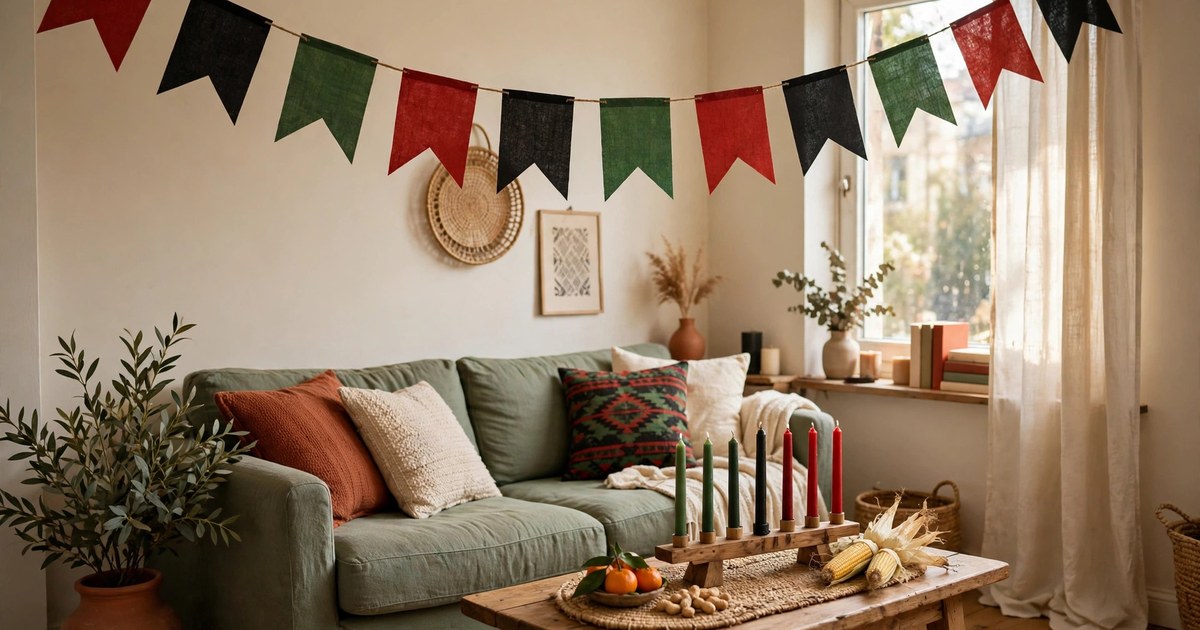
Bunting is the fastest way to make a small room feel festive, and a string of red, black and green flags is the Kwanzaa version of the classic paper chain. A ready-made fabric or paper bunting in the three Kwanzaa colours costs around $8 to $15, and a homemade one costs almost nothing: cut triangles from coloured card or leftover fabric, fold them over a length of string or ribbon, and you have a garland in an evening. The trick in a rental is hanging it without damage, and that is where removable adhesive hooks earn their keep once again.
Hang the bunting across a doorway, along the top of a bookshelf or in a gentle swag above the kinara display. Small removable hooks spaced along the line hold a lightweight paper bunting easily, and they come away without a trace when the week ends. Drape the bunting in a soft curve rather than pulling it taut — a gentle swag looks far more celebratory than a straight line — and let the flags alternate red, black and green so the colours read clearly from across the room. A two-metre length suits a doorway or a shelf; a three-metre length spans a sofa wall.
Paper bunting is wonderfully forgiving in a small flat. It weighs almost nothing, it packs flat for next year, and if a flag tears, you can replace it in minutes. Fabric bunting costs a little more but lasts for years and looks softer in a cosy room. Either way, this is one of those decorations that does a surprising amount of work for very little money: one string of flags, and the whole room reads as dressed for a celebration. If you are short on time, hang the bunting first and build the rest of the display around it — it sets the colour story for everything else.
9. A gratitude corn display (muhindi)
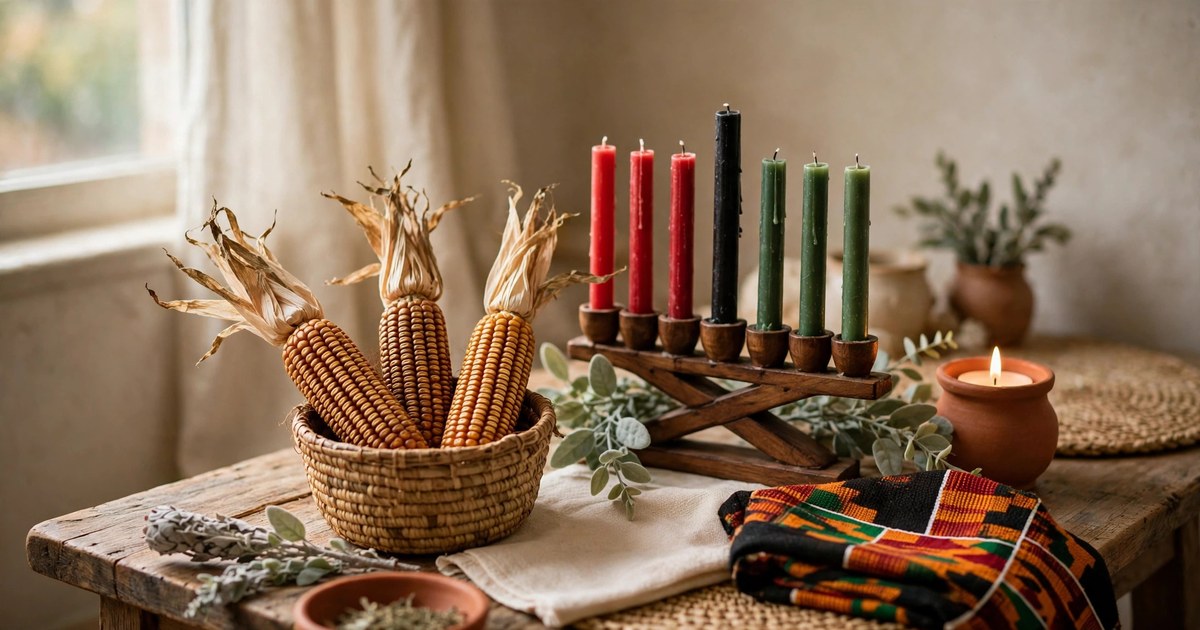
Muhindi, the corn, represents the children of the family — one ear for each child — and a small corn display is one of the most touching parts of a Kwanzaa table. Dried corn on the cob, in warm golds and deep reds, costs very little: a few ears from a market stall or a craft shop usually run to $5 to $10, and a small bag of dried corn kernels in a glass jar costs even less. Arrange two or three ears in a small basket or a low bowl on the mkeka mat, or stand them upright in a jug for a taller, more sculptural look.
The beauty of corn is its colour and texture. The golden kernels pick up candlelight beautifully, and the rough husks sit in lovely contrast to the smooth candles and glossy fruit around them. If you have children, let each child choose or decorate their own ear — a ribbon tied around the husk in red, black or green makes it personal, and the display becomes a talking point rather than just a decoration. In a home without children, a single ear still belongs on the display as a symbol of future generations and hope, so do not skip it.
Corn is also one of the easiest Kwanzaa symbols to source on a budget. Dried corn keeps for years if stored somewhere dry, so the ears you buy this December will be ready to use again next year, and a glass jar of kernels doubles as a pretty kitchen decoration long after the holiday ends. Keep the display small — two or three ears are plenty on a sideboard — and let the corn sit close to the kinara so the whole display reads as one connected story rather than a row of separate objects.
10. Warm lighting and a Kwanzaa book stack
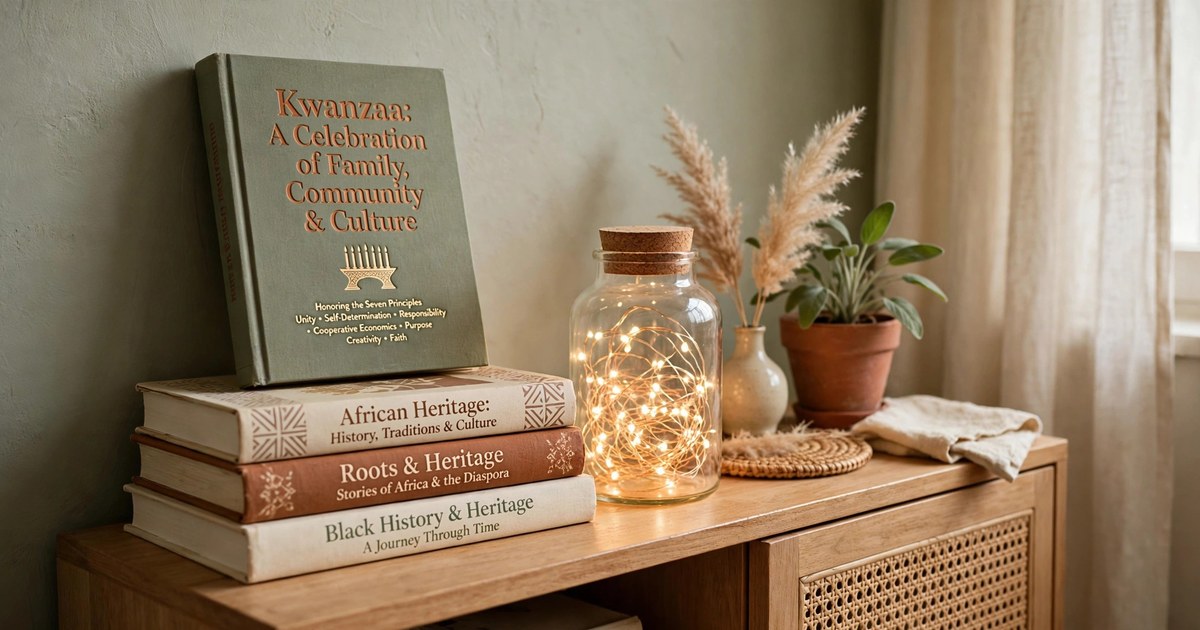
The final idea ties the whole display together: warm light and a small stack of books. Battery-operated fairy lights in warm white, draped along a shelf or coiled inside a glass jar, give a small flat the glow that makes Kwanzaa evenings feel special, and they are the renter's safest lighting choice — no wiring, no plugs near curtains, no heat, and a string costs around $6 to $12. Drape a single string along the top of the sideboard behind the kinara, or coil one inside a large jar beside the display, and the candles and the fairy lights will warm each other beautifully once the main lights go down.
Beside the lights, stack two or three books about Kwanzaa, African heritage or Black history — a children's picture book on top makes a lovely touch if little ones are celebrating with you. The books do two jobs at once: they anchor the display visually, giving the candles and the cup something solid to sit beside, and they invite conversation about what the week means. A stack of books is also the easiest styling trick in the book, quite literally: vary the sizes, keep the spines in warm or muted tones, and top the stack with a small object — a candle, a piece of fruit or a sprig of greenery — so it feels finished rather than accidental.
This is the idea that costs least and gives most, because you may already own everything it needs: a string of fairy lights from another holiday and a few books from your own shelves. Together, light and books turn a display of objects into a corner of the room that invites people to sit down, stay a while and talk — which is, after all, what Kwanzaa is for. When the week ends, the lights go back in their box and the books go back on the shelf, and the flat returns to normal with nothing to repair and nothing to regret.
A Kwanzaa display in a small rented flat does not need to be large to be meaningful. A kinara on a woven mat, a few cushions in kente colours, a basket of fruit and the warm glow of candles are enough to honour the seven principles and to make the week feel special. Everything here comes down without a mark, packs away for next year and costs less than a single takeaway dinner for the whole look. That is the real lesson of Kwanzaa decor for renters: the celebration lives in the gathering, not in the square footage.
If you are decorating for more than one winter holiday this year, our guide to renter-friendly Hanukkah decor under $25 uses the same removable-hook and flameless-candle tricks, and our renter-friendly Christmas garland ideas will help you dress a small flat for the whole season without risking your deposit.
Shop this look: Kwanzaa decor basics
- Kinara candle holder set — the seven-branched centrepiece every Kwanzaa display starts with. Shop kinara candle holder set
- Kente cushion covers — bold woven-stripe covers that bring Kwanzaa colours to the sofa in minutes. Shop kente cushion covers
- Woven seagrass basket — a shallow basket for the mazao fruit display, then storage all year. Shop woven seagrass basket
- Red black green candles — taper and pillar candles in Kwanzaa colours for the kinara and table trios. Shop red black green candles
- African print wall tapestry — a lightweight fabric panel that hangs on removable hooks with no damage. Shop African print wall tapestry
- Battery fairy lights — warm-white LED string lights for a safe, cosy Kwanzaa glow. Shop battery fairy lights
Frequently Asked Questions
What are the seven principles of Kwanzaa?
Kwanzaa is built around the Nguzo Saba, seven principles celebrated one per day from 26 December to 1 January: unity (Umoja), self-determination (Kujichagulia), collective work and responsibility (Ujima), cooperative economics (Ujamaa), purpose (Nia), creativity (Kuumba) and faith (Imani). Each evening a candle is lit on the kinara and the principle of the day is discussed, so the display grows brighter as the week goes on.
Can I celebrate Kwanzaa in a rented flat with a no-candles rule?
Yes — and many renters do. Battery-operated taper candles in red, black and green fit a standard kinara and give you the same nightly lighting ritual with no flame, no wax and no risk to your deposit. Pair them with fairy lights and the warm glow of the display stays completely intact, and your tenancy agreement stays intact too.
What colours should Kwanzaa decor use?
The three Kwanzaa colours are red, black and green: black for the people, red for the struggle and green for the future and hope. Gold is often added as a warm accent, especially in kente-inspired textiles. Keep the palette to those three colours plus natural straw, wood and cream tones, and the display will look coherent even in a very small room.
How much space does a Kwanzaa display need?
Very little. A full display — kinara, mkeka mat, unity cup, fruit basket and corn — fits on a surface about 60 centimetres wide, such as a sideboard, a console table or a sturdy shelf. That is why Kwanzaa suits small apartments so well: the celebration is gathered in one place rather than spread around the room, and a single well-styled surface is all it takes.
How do I take Kwanzaa decor down without damaging the walls?
Peel removable adhesive hooks away slowly, following the packet instructions, and they leave no mark. Fold fabric hangings and bunting flat, roll the mkeka mat up, and pack candles and the kinara in tissue so they survive until next year. Avoid tape, pins and nails entirely — everything in this guide hangs on hooks or sits on a surface, so taking it down is as damage-free as putting it up.